Recognizing the Stranger
Reweaving a Social Fabric of Neighborliness
Vision
|
Recognizing the Stranger is a multi-year leadership development initiative launched in 2017 with support from the Catholic Campaign for Human Development. Rooted in faith traditions that affirm the dignity of every person, the program invests in immigrant leadership while strengthening bonds across language, culture, and status. Immigrant and non-immigrant leaders learn the skills of public life, relational organizing, and civic engagement — building solidarity grounded in shared responsibility for the common good. This work moves deliberately from reflection to action. Through disciplined listening, discernment, and public engagement, communities build the relational power needed to strengthen parish and neighborhood life and shape the broader civic culture. To date, over 5,000 leaders from 370 parishes across 20 dioceses have been trained, growing a constituency committed to the safety, dignity, and full participation of immigrant families. When communities organize across lines of difference, they make visible a democracy that honors the dignity that is our shared birthright. |
Strategy
How It Works
- Invest in immigrant leadership with advanced Spanish-language training to build their ability to conduct specialized workshops and civic academies in their home parishes,
- Teach immigrant leaders how to impact parish, school and community life through alliances with non-immigrants, and
- Develop the strategic regional capacity to create new relationships of mutual understanding and trust to inform and expand a pro-immigrant constituency.
Recognizing the Stranger starts by investing in the capacity of immigrant families both to claim the agency and dignity of personhood that is their birthright and to build, with their non-immigrant neighbors, a constituency to address the concerns of poor and low-income families. The strategy works at the diocesan level with local parishes and with other community-based institutions to identify, train, and mentor immigrant leaders in the skills of public life- skills necessary to build connections among themselves and with allies in their parishes and in the broader community.
Currently, participants are demonstrating a heightened sense of parish leadership, a clearer awareness of the mission of the church, and are actively engaging larger groups of fellow parishioners, with the long-term goal of forming greater solidarity between immigrant leaders and native born community members.
Elements of Training
Recognizing the Stranger collaborates with local dioceses, Catholic parishes, and community-based institutions to identify institutional leadership teams to participate in multi-day Spanish language Leadership Training Institutes, with the goal of preparing teams of lay leaders to return to engage and contribute to their institutions. The training is led by Spanish speaking organizers and key lay leaders from the West/Southwest IAF with deep experience in broad-based organizing.
The curriculum, which blends Catholic teaching with relational organizing practices, focuses heavily on understanding the mission of the church and the responsibilities of parish leaders. As such, the structure of the training is built around an understanding of the sacramental life of the parish, namely Eucharist and Baptism.
Recognizing the Stranger draws deeply from scriptural reflections, including First Corinthians (1 Cor 11), the Road to Emmaus (Luke 24:13-35), and Nehemiah’s reconstruction of the wall of Jerusalem. By rebuilding the church community, encounter by encounter, people come to a new realization of who is their neighbor, restoring dignity and human agency.
What Happens After Training?
IAF organizing processes are similar to that of the synod:
SEE: In roundtable discussions, parishioners and neighbors are invited to make public their private pain and experience. These conversations are a place of encounter, where the poor are recognized and the gravity of their situations more fully realized.
JUDGE: Leaders begin a process of discernment – probing to determine the full nature of what is challenging the community, forming a judgment of what is humane and what is not humane. What should justice and compassion look like?
ACT: Institutional members are invited to take collective action – to come together with a common vision and, often, to call on public officials and other allies to help make it a reality. By coming together with different types of civic institutions across lines of language, class, religion and ethnicity, the people build and demonstrate relational power – the ability to make change together.
Impact
-

Stopping Immigration Detention Expansion & Demanding Accountability
In 2026, EPISO halted the nation’s largest proposed ICE detention center in Socorro, TX after parishioners raised moral objections and warned of the center’s strain on their small water system.
One LA compelled the City of Los Angeles to host the nation’s first congressional hearing on immigration raids, establishing a public record of civil rights violations (more here). This came after training hundreds through “Freedom Schools” and testifying for 40 minutes on the human cost of immigration enforcement.
Local affiliates in San Antonio, TX, and Pacoima and Pomona, CA sparked field hearings with members of Congress on a proposed ICE warehouse and the community impact of immigration enforcement and mass deportation. These have resulted in legal action and a bill to direct millions of dollars to mental health services for those impacted
-
Securing $125M in Annual Support for Undocumented Families with Young Children
Responding to "the lament of the people" during the pandemic, hundreds of California IAF leaders and Bishops organized over zoom and demanded that the Governor and legislature provide immediate relief for essential workers left out of state and federal relief. Now, undocumented families with young children have access to life-sustaining payments in the form of the California Earned Income Tax Credit (Cal EITC) - an expansion worth $125 Million per year.
-
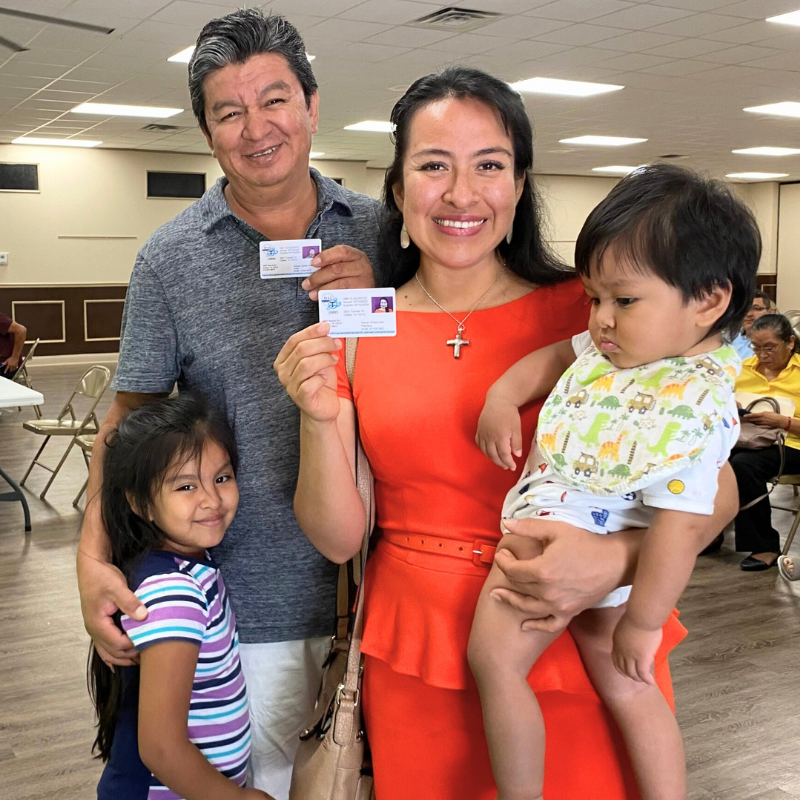 Organizing Parish IDs to Protect Immigrant Families
After Texas denied driver’s licenses to undocumented immigrants and passed SB4 in 2017, DAI leaders organized to reduce families’ vulnerability. Partnering with the Catholic Diocese of Dallas, they convened 1,500 parishioners and secured public commitments from three police chiefs to recognize parish-issued identification cards, allowing immigrants to drive to work and school without risking detention (more here).
Similar agreements in the Dioceses of Brownsville (with Valley Interfaith) and Tucson (with Pima County Interfaith) now reduce the risk of deportation for tens of thousands of families.
-
Leveraging $385 Million in Rental Assistance to Prevent Evictions
When the pandemic devastated service and construction jobs, leaders organized to protect immigrant families from eviction. In Brazoria County, parish leaders successfully challenged barriers that excluded undocumented families from federal rental aid, negotiating changes that expanded access. Across the West/Southwest IAF network, leaders helped leverage more than $385 million in rental assistance — ensuring taxpaying immigrants, regardless of status, were included (more here).
-
Creating Job Training Opportunities

Faced with severe job loss in their communities during the pandemic, COPS/Metro leadersproposed what they dubbed a "new GI Bill," modeled after the IAF's flagship workforce development program, Project Quest. Organizing support from the Mayor, County Judge, Alamo Colleges, and San Antonio voters, COPS/Metro's "San Antonio Ready to Work" passed by 77%, resulting in at least $230 million to support workers training for new jobs.
News
 Cti
500+ CTI Leaders Leverage Commitments...
“In the face of the State’s punitive measures towards its...
 Rio grande valley
600 Valley Interfaith Leaders Unveil...
[Excerpt] Father Kevin Collins, of St. Eugene de Mazenod, told...
 Tmo
TMO Leverages Commitments from Dem....
[Excerpts] The Democratic and Republican candidates for Harris County judge...
 Victory
COPS/Metro Sets Congressional Field Hearing...
The field hearing in San Antonio was preceded by a...
Let's Stay Connected
Get updates on initiatives, stories, and ways to build a more just and connected world — straight to your inbox.