
Click here for West/Southwest IAF Key Victories in 2024
Texas IAF Blocks Billions in State Tax Giveaways to Big Oil

[Excerpts]
When organizers set out to overturn Texas’s giveaway program for the oil and gas industry, they had a long game in mind. Over 20 years, the tax exemption program known as Chapter 313 had delivered $10 billion in tax cuts to corporations operating in Texas — with petrochemical firms being the biggest winners. This year, for the first time in a decade, the program was up for reauthorization. Organizers decided to challenge it for the first time.
At the beginning of last week, as Texas’s biennial legislative session approached its end, the aims of organizers remained modest. “We thought it would be a victory if the two-year reauthorization passed so we could organize in interim,” said Doug Greco, the lead organizer for Central Texas Interfaith, one of the organizations fighting to end the subsidy program.
At 4 a.m. last Thursday, it became clear that something unexpected was happening: The deadline for reauthorization passed. “The bill never came up,” Greco told The Intercept. Organizers stayed vigilant until the legislative session officially closed on Monday at midnight, but the reauthorization did not materialize....
“No one had really questioned this program,” said Greco, of Central Texas Interfaith.
The reauthorization was a once-in-a-decade chance to challenge it. “We knew in our guts that the program was just a blank check, but we also are very sober about the realities of the Texas legislature.” ....an unlikely coalition...emerged from across the political spectrum — including the right-wing Texas Public Policy Foundation, the progressive Every Texan, and [Texas IAF], which does nonpartisan political work among religious groups.
....
The Texas Chapter 313 defeat is the second recent win against multibillion-dollar oil and gas industry subsidies in fossil fuel states. Last fall, organizers in Louisiana beat back a ballot initiative designed to counteract dramatic reforms to the state’s industry giveaway program. In a state that leans heavily Republican, people voted down the constitutional amendment by a landslide.
Broderick Bagert, who helped organize the Louisiana effort, sees what happened in Texas as part of a turning of the tides in a region where industry has long ruled. “In a lot of cases, it’s not that these battles have been lost — they just haven’t been fought,” he said. “What you’re seeing for the first time is the battles being fought.”
....Bagert noted that Louisiana and Texas are two of a handful of states whose industries will decide what our climate future will look like. “The question of these subsidies is being tied more and more with the question of whether these changes in energy production that we need to save the planet are going to be made in time to save the planet,” he said. “It all boils down to the price of energy. Once industries have to bear the full cost of their production, including emissions and taxes and all the other things that have been subsidized, then it’s no longer advantageous, and that’s when things start happening.”
In Blow to Big Oil, Corporate Subsidy Quietly Dies in Texas, The Intercept [pdf]
Texas Legislature Dooms Chapter 331, Which Gives Tax Breaks to Big Businesses, Business Journal [pdf]
Missed Deadline Could Doom Controversial $10B Tax-Break Program, Houston Chronicle
A Texas Law Offers Tax Breaks to Companies, but It's Renewal Isn't a Done Deal, Texas Tribune [pdf]
A Controversial Tax Program Promised High Paying Jobs. Instead, Its Costs Spiraled Out of Control, Houston Chronicle [pdf]
Losers and Winners from Chapter 313, Central Texas Interfaith
The Unlikely Demise of Texas’ Biggest Corporate Tax Break, Texas Observer [pdf]

June 02, 2021
Arizona Interfaith Network Condemns Flat Tax as Immoral. State Budget Talks Stall.

[Excerpts]
Members of Arizona's faith community gathered at the Arizona Capitol on Thursday to condemn the proposed 2.5% flat tax, saying it would disproportionately impact marginalized communities and that they would be "among the first" to call for a referendum if it passes.
The Arizona Interfaith Network, a statewide coalition of organizations including the Valley Interfaith Project, Northern Arizona Interfaith Council and Yuma County Interfaith, held the news conference at 10 a.m.
The Rev. Martha Seaman, a deacon at Church of the Epiphany-Tempe who also serves as president of the Valley Interfaith Project board, began the conference by calling the flat tax a "dangerous" proposal....
The Rev. Hunter Ruffin, a senior pastor at Church of the Ephiphany-Tempe, said the lost tax revenue would "cripple our state for generations to come" and called the state budget "one of our most basic moral documents" that reflects who and what is prioritized in Arizona.
Ruffin said the "immoral" flat tax would benefit wealthy Arizonans at the cost of the poor and middle class, which he described as antithetical to religious teaching. "You can turn to Leviticus, to Ezekiel, to Zachariah, to Malachi, to the gospels of Matthew, Mark, Luke and John, to the whole of the Pauline epistles....
"we're taught to care for the most vulnerable among us first, not simply when we have extra in our pockets and we feel charitable."
If the flat tax passes, Ruffin said the Arizona Interfaith Network would be "among the first" to call for a referendum, a measure in which voters can veto a law by gathering enough signatures to get the issue on the ballot.
He said the network would also be launching a series of community and congregational study sessions to further explore the flat tax and its implications.
[Photo credit: (right) Matthew Casey, KJZZ; (left) ABC News]
Oped: First the Pandemic, Now a Flat Tax. Haven't Arizona's Most Vulnerable Suffered Enough?” The Arizona Republic [pdf]
Arizona Faith Leaders Condemn Proposed Flat Tax, Say They Will Call Referendum, The Arizona Republic [pdf]
Arizona State Senate Cannot Find Agreement on the Budget, Joins the House in Recess, ABC Arizona [pdf]
Faith Coalition Calls Arizona Budget Proposal Immoral, KJZZ [pdf]
AIN Clergy Denounce the Flat Tax Proposal, Valley Interfaith Project
May 27, 2021
In Advance of Hurricane Season, TMO & Texas IAF Fight for Energy Grid Weatherization and Help with Repairs

 [Excerpt]
….[t]he Network of Texas IAF Organizations – a nonpartisan coalition of mostly faith-based organizations that represents more than one million people — and The Metropolitan Organization of Houston, held a virtual press conference April 12 to support approval of State Senate Bill 3, mandating weatherization under federal energy regulation guidelines.
They are calling for the costs to be covered by power producers and energy generators as well as through the state’s $10 billion “rainy day” fund. The bill passed in the Senate on March 29 and now moves to the House that heard testimony but has not taken a vote. It would also impose penalties for non-compliance, increase coordination among state energy regulating bodies and create an emergency alert system.
Faith organizations also called for establishing a $2 billion fund to help families pay for home and apartment repairs and for consumer advocates to be appointed to all state energy and utility boards.
Sister Maureen O’Connell, OP, Archdiocese of Galveston-Houston director of the Secretariat for Social Concerns, said, “Never again – the damage that this past storm inflicted on families should never happen again because of lack of preparation by the state.”
“People are still suffering and can’t make repairs on their own homes. It’s criminal not to help. The community, including the State Legislature, needs to support one another,” she said.
....Since many lost wages or jobs because of the pandemic, they remain living with mold in their homes from busted pipes and filling bathtubs with water, DeLeon described. The ministry, with limited funds, can help each family only once every six months, she said. “This is only a temporary fix. The community’s problems are much bigger.”
[CNS photo: Callaghan O'Hare, Reuters]
With Hurricane Season Looming, Families Still Suffer from Winter Storm, Texas Catholic Herald - Archdiocese of Galveston [pdf]
May 11, 2021
Together New Orleans Engages Neighborhood Around Vaccinations with Help of Church, Music and Food

[Excerpt]
The event was held at St. Maria Gorretti Catholic Church, in a neighborhood in New Orleans East with one of the lowest vaccination rates in the city at just under 7 percent as of March 31. For two weeks canvassers from Together Louisiana walked the area’s streets, handing out flyers and attempting to make appointments for people who hadn’t already been vaccinated against the coronavirus.
For the group’s last canvassing effort, they brought along the band.
As demand for COVID-19 vaccine declines, public health officials say on-the-ground efforts like this are what’s needed....For canvassers Mimi Ayers and Katie Perry, engagement looks like sharing their vaccination stories whenever people they encounter have questions about the experience. “I'll say, ‘I got vaccinated. I did the Moderna shot. Here were my symptoms.’ Because I think it helps a lot for them to have a real person in front of them who's taken it. One person actually [told me] that,” Perry said.
...The Together Louisiana approach is derived from the organization’s efforts to engage voters during elections. The nonprofit is a partner in the Louisiana Department of Health’s “Bring Back Louisiana” campaign to reach herd immunity against the coronavirus....
“What can make something exciting more than food and music, particularly for New Orleans?” Lloyd of Together Louisiana said. “When you went canvassing and told people, ‘Hey, we're having this event, come on out, anyone who comes out can get vaccinated, and we're also going to have fish and a brass band, people's faces lit up.”...Together Louisiana plans to host another event at St. Maria Gorretti on May 29 to provide second shots for patients who got first doses on Saturday.
Photo Credit: Bobbi-Jeanne Misick, New Orleans Public Radio
The Latest Phase of Covid-19 Vaccine Rollout Is Slow, Deliberate and on the Ground, New Orleans Public Radio [pdf]
May 07, 2021
CCG Leaders Raise Flag About Bias in School Accountability System

[Excerpt]
"I have seen firsthand how this accountability system targets neighborhood schools and our students of color,” said Germaine Padberg-Ludlow, a Denver elementary teacher and member of Coloradans for the Common Good, a coalition of community, union and faith groups supporting the audit.
Padberg-Ludlow previously taught at Denver’s John Amesse Elementary School, which was closed and then reopened with new leadership over the objections of parents and teachers. At the time, Denver Public Schools had its own rating system and a more aggressive school closure process than required by state law. She said the system drives teacher turnover, forcing students to build new relationships and widening achievement gaps.
[Photo credits: Nathan W. Armes, Chalkbeat, left; Coloradans for the Common Good,right]
Colorado School Accountability Audit Moves Forward, Chalkbeat [pdf]
May 06, 2021
DAI Calls Shelter Conditions for Migrant Teens a 'Humanitarian Crisis'

[Excerpts]
Some of the dozen people familiar with the conditions who spoke to The Dallas Morning News about the center say the management of the boys’ asylum cases seems chaotic, with boys unclear about processes such as their pending family reunions, deportation cases, or why they are being held.
“This is a humanitarian crisis in the convention center,”
said Josephine Lopez-Paul, Dallas Area Interfaith’s lead organizer, who did volunteer work at the convention center. Like others interviewed, Lopez-Paul was taken aback by the number of children, mostly from Guatemala and Honduras, kept in one massive gray hall of the convention center, their metal cots in neat rows.
The Dallas center was initially billed as a “decompression center” for children, and after it opened on March 17, it quickly filled to capacity, about 2,300 boys ages 13 to 17.
But many who have worked or volunteered there have described the pop-up detention center as inadequate and depressing for the children, though they acknowledge it’s better than conditions at the Border Patrol sites where they are initially processed after crossing the border seeking asylum in the U.S.
[Photo Credit: Dallas Visitor's Bureau]
Worries Rise About the Welfare of Migrant Teens in Dallas Emergency Shelter, Dallas Morning News [pdf]
Migrant Teens Held in Dallas Convention Center Feel Imprisoned, Dallas Observer [pdf]
Advocates Worried for Migrant Teens at Improvised Shelter, Arkansas Democrat Gazette [pdf]
May 05, 2021
AMOS Chronicles Olympian Story Behind New Olympic-Trial Skatepark

[Excerpt]
The Rev. Bill Cotton wasn’t sure he was seeing what he was seeing. As a civil rights leader, the longtime pastor of Grace United Methodist in Des Moines, and founding member of the grassroots organization AMOS (A Mid-Iowa Organizing Strategy), he had seen a lot. But he never thought he would see a teenager on the roof of one of his two adjoining church garages attempt to jump the gap between them on a skateboard. Fortunately, the skater made the jump, Bill didn’t have a heart attack, and he did what everyone does to annoying skateboarders — he shooed them away.
Little did Bill, who has since died, know that those skaters, from his own congregation, would join AMOS and start a revolution in Des Moines.
The skaters were part of the Grace United Methodist Church youth group, and when AMOS organized a large-scale community listening campaign, they met with that youth group and heard of the need for a first-class skatepark in Des Moines. That led AMOS to Callanan Middle School’s newly formed skateboard club, where they heard more of the same. The AMOS adults challenged the youth to organize a presentation to Des Moines’ mayor and City Council at an upcoming AMOS Issues Assembly....
[Photo Credit: Community Foundation of Greater Des Moines]
Des Moines Lauridsen Skatepark: Tracing a 17-year Journey, From a Nuisance to a Metro Treasure, Des Moines Register [pdf]
There From the Beginning: Lauridsen Skatepark, Des Moines Community Foundation [video]
May 05, 2021
Incumbents Who Participated in COPS/Metro Accountability Assembly Win Re-election. Non-Incumbent Candidates Advance to Runoff
[Excerpts]
Rick Casey: A Very Strange Election in San Antonio, San Antonio Report
May 04, 2021
In 'Act of Love,' VIP Engages 500 Neighbors Ahead of Vaccination Clinic
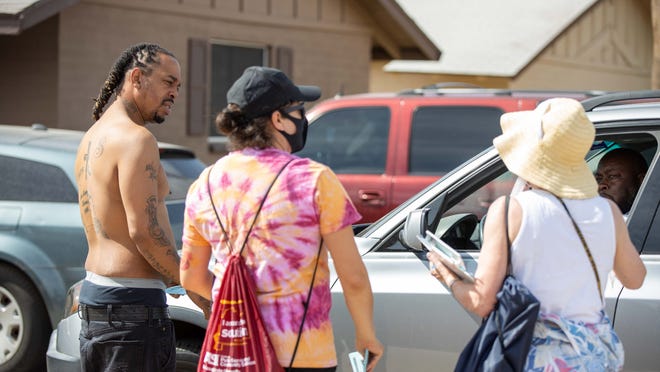
[Excerpt]
Monica Dorsey said about 500 homes in Maryvale were visited on Saturday and that she "absolutely" believes the effort will translate into higher vaccination rates.
She said the goal is to vaccinate between 1,500 and 1,800 people through May, adding that it is the "best feeling in the world" to know that Maryvale, and the larger Phoenix area, would be safer because of it.
Dorsey said the door-to-door efforts are also a key part in disseminating vaccine information, adding that "personal contact seems to make so much of a difference."
"Everybody is convinced social media is the way to reach people, but if you want to really, really reach them, you have to see them, talk to them, find out what's on their mind, hear their stories," she said. "It's so important and it is effective and we'll stay at it until percentages get where they need to be."
[Photo Credit: Drake Presto, The Republic]
May 01, 2021
VIP, with Daughters of Charity, Brings Covid-19 Vaccines to Neighborhood & Knocks On Doors to Invite Residents

Valley Interfaith Project (VIP) leaders, with the Daughters of Charity Sisters at St. Vincent de Paul Catholic Church and School have begun knocking on doors and talking about the vaccine with residents around St. Vincent de Paul Church to ensure that all residents have the opportunity to get vaccinated.
[Photo Credit: Univision]
Invitan a la Comunidad a Vacunarse Contra el Coronavirus este 5 de Mayo en el Condado Maricopa, Univision [Video]
April 28, 2021