
Click here for West/Southwest IAF Key Victories in 2024
With Evictions Looming, IAF Organizations in Arizona & Texas Fight to Keep Families Housed

[Excerpts]
Arreola has received some help from Voices United for Life, a pro-life organization. And in December, she joined online house meetings organized by the Valley Interfaith Project, a onetime Catholic Campaign for Human Development-funded organization that now advocates for people facing eviction during the pandemic.
Valley Interfaith [Project], she said, has "given me a voice."
Advocacy on eviction prevention has become an important part of this work as well. The Archdiocese of Galveston-Houston is affiliated with The Metropolitan Organization, a CCHD-fund grassroots organization that has taken on eviction prevention work since March.
St. John the Baptist Parish in Alvin, Texas, a Metropolitan Organization member, has provided partial rental support for about 30 families in which the primary earner has lost work as industries like construction and landscaping have retrenched under the pandemic.
For months advocates in Dallas have pushed officials to distribute rental assistance funds and expand the Centers for Disease Control moratorium on evictions. Dallas Auxiliary Bishop Greg Kelly has worked with CCHD-funded Dallas Area Interfaith on the effort.
"It's very harmful," Bishop Kelly said of the restrictions on accessing the money. "There's no need for it either. The funds are there."
Josephine Lopez Paul, lead organizer of Dallas Area Interfaith, said work continues on empowering and educating people about eviction prevention in the hope their voices will influence policymakers to better respond to their needs.
[Photo Credit: Lucy Nicholson/Reuters]
With Evictions Looming, Agencies Furiously Work to Keep Families Housed, Angelus Catholic News Services [pdf]

January 12, 2021
Statement on the Insurrection at the U.S. Capitol
 The violent incursion at the U.S. Capitol on Wednesday, January 6 disrespected, demeaned, and threatened the right of every citizen who peaceably engages in the democratic process in our country.
Deliberation, debate, argument, compromise, deal-making; these are the means to advance interests in a democracy. The leaders and organizations of the West/Southwest IAF teach and practice these political skills every day; vigorously engaging on the issues that impact our families and traveling regularly to state Capitols, City Halls, and decision-making chambers to advance these issues. That the buildings and halls of power belong to them is made self-evident in their consistent and persistent presence throughout years of effort. Their work is carried out through hundreds of conversations full of respectful dissent, concession, and sometimes victory; in other words, democratically.
What happened yesterday at the U.S. Capitol not only endangered the officials, staff members and public safety officers who were present, but endangered our democratic institutions by introducing violence to what has, until now, been a tradition of a peaceful transfer of power in our national leadership. To arrive at consent at the point of a gun is the weakest form of power, and our nation was weakened on January 6 by the use of violence in place of political debate.
As a network of religious, labor, education and community leaders from all walks of life and all political persuasions, we condemn the acts of insurrection and violence in Washington, D.C., and recall the words of Abraham Lincoln in his second inaugural address at the conclusion of the Civil War: "With malice toward none; with charity for all; with firmness in the right, as God gives us to see the right, let us strive on to finish the work we are in; to bind up the nation's wounds; to care for him who shall have borne the battle, and for his widow, and his orphan -- to do all which may achieve and cherish a just, and lasting peace, among ourselves, and with all nations."
Cortes: To Arrive at Consent at Point of a Gun is Weakest Form of Power, Rio Grande Guardian [pdf]
In Wake of Capitol Attack, Leaders Urge Rejection of Division That Lead to Violence, Catholic Sentinel [pdf]
Listen to Lincoln: 'With Malice Towards None; With Charity For All', Arizona Republic [pdf]
Statement, West/Southwest IAF
January 08, 2021
CCG Expands Student Access to Jeffco Schools Meals by +300%

[Excerpts]
Recently, Jeffco’s program has been under fire from leaders in the faith, nonprofit, service and education communities. A virtual forum was held Dec. 9, 2020, hosted by the group, Coloradans for the Common Good (formerly Colorado IAF). Pastor Reagan Humber, House for All Sinners and Saints, led the meeting. Taking the District to task for what he considered inadequate access to the program for families in need, Humber called on Interim Superintendent Kristopher Schuh to meet with representatives from the group to discuss changes. In a separate interview, he said the CCG coalition’s main concern was what they perceived to be deficiencies in Jeffco’s program in comparison to similar programs.
“Denver and Cherry Creek are open every day for kids to be able to get hot lunch,” Humber said.
While he agrees the recent expansion of hours and locations is a step in the right direction, his group is still concerned about distances between pick-up points creating long walks for kids who have no other transportation options to pick up meals.
Regarding the newly launched bus delivery routes, Humber said his group is thrilled the District has begun this pilot program, and delighted to know their efforts in highlighting the issue paid off.
He also sees issues with meals the district provides that require reheating, pointing out the need for ready to eat options for families who are homeless or living in cars.
As for the meeting between Schuh and the CCG folks, Humber said the Interim Superintendent has tentatively agreed, but no date has been set.
[Photo Credit: Glenn Wallace/Golden Transcript]
Jeffco Schools Pivot — Expand Grab and Go Food Program, Golden Transcript [pdf]
Jeffco Schools Pivot — Expand Grab and Go Food Program, Arvada Press [pdf]
December 31, 2020
Our Pandemic Response


December 31, 2020
At COPA's Urging, Monterey County Launches $4.9M Pilot Health Promotion Program

In late December, COPA leaders celebrated the unanimous decision by the Monterey County Board of Supervisors to invest nearly $5 million in a six-month Community Outreach & Education pilot program targeting neighborhoods hardest hit by COVID-19. This program will hire 100 community health workers -- trusted people from community-based organizations -- starting January 1, 2021. These trained workers will help educate families, as well as connect people who test positive with needed services, including temporary housing for quarantine or isolation, cash assistance, food, medical care and information about employment rights. Workers will target the hardest hit Census tracts.
The program proposal, created by COPA’s “Breaking the Chain” team, was based on more than 2,000 conversations with Monterey County families impacted by COVID-19, and is similar to other programs in California. In the midst of the pandemic, leaders from COPA’s 28 member institutions launched a listening campaign in which they heard stories about the need for rental assistance; access to testing, tracing, and supported isolation; and access to education and distance learning resources.
Allies spoke in support of the proposal including Building Healthy Communities, Center for Community Advocacy, California Rural Legal Assistance, the Monterey County Farm Bureau, Catholic Diocese of Monterey and the Hospitality Industry Association.
Monterey County Board of Supervisors Approves Nearly $5 Million for COVID-19 Program, The Californian [pdf]
Monterey County Supervisors Approve Pilot Project to Help Those Disproportionately Impacted by COVID-19, KION [pdf]
Supervisors Approve Nearly $5 Million to Put Trusted Health Workers into Neighborhoods Suffering Under Covid, Monterey County Weekly [pdf]
County Supervisors to Consider $2.3 Million to Fund Pilot Program Targeting Neighborhoods Hit Hardest by Covid, Monterey County [pdf]
December 21, 2020
CCG Backs UFCW in Fight to Reinstate Hazard Pay & Safety Protocols for Grocery Store Workers

[Excerpts]
Grocery store workers belonging to United Food and Commercial Workers Local 7 made their case Wednesday for reinstating hazard pay and safety protocols during COVID-19...
Union leadership, Coloradans for the Common Good faith leaders and the family member of a worker killed by COVID-19 [jointly called] a virtual press conference to address the conditions grocery store employees throughout the state are facing.
“Leaders of CCG are here today out of our concern for grocery store workers who are essential workers and have been a particular risk during this pandemic," Marilyn Winokur of CCG said. "We believe we need to do everything in our power to protect them and our communities while they continue to work.”
Winokur noted that CCG wrote letters to both Steve Burnham, president of King Soopers, and Todd Broderick, president of the Denver Division of Albertsons Companies, to ask for a meeting to discuss the concerns surrounding grocery store employees.
Both CCG and UFCW Local 7 noted the two main asks are for stores to reinforce hazard pay and safety measures to keep workers, customers and communities safe.
[Photo Credit: CBSN Denver]
'From Heroes to Zeros': Grocery Store Employees Seek Return of Hazard Pay as COVID-19 Ramps Up, Pueblo Chieftain [pdf]
Colorado Grocery Store Workers Ask for Reinstated Hazard Pay, KOAA News55 [pdf]
Grocery Worker Union Wants Reinstatement of Hazard Pay, CBSN Denver [pdf]
December 17, 2020
CCG Fights to Expand Student Access to School Meals in Winter Pandemic Surge

[Excerpts]
Led by Coloradans for the Common Good, the organizations convened virtually last week, concerned primarily about the roadblocks that stand in the way of families being able to fully access the meals that Jeffco Public Schools has been distributing this fall. Problems with scheduling and transportation mean some kids and their family members may be going hungry.
“Our schools, for better or worse, have become a central part of our social safety net, and our social safety net is already deeply frayed in our country,” said Reagan Humber, a member of the group’s steering committee and pastor at House for All Sinners and Saints in Denver. “And so kids are depending even more on that food.”
Members of Coloradans for the Common Good worry that the district doesn’t operate enough distribution sites across communities so that all families in need can pick up food nearby, including those who are limited by transportation. They’re just as concerned that the sites don’t offer the kind of flexible hours that cater to families’ schedules.
...
Humber would like to see Jeffco Public Schools bus food across the community, noting that drivers have agreed to transport meals to students so that they don’t have to walk miles to pick up food. He is also urging the district to ensure a school in every town it serves offers meal distribution and that every neighborhood serving a population of students who attend a Title I school has nearby access to school meals.
[Photo Credit: Brandan Robertson/Colorado Sun]
About a Third of Jeffco Students Qualify for Subsidized Meals. There Are Fears Many Can't Access Them During Coronavirus, Colorado Sun [pdf]
December 16, 2020
Arizona Interfaith Calls on Governor for Moratorium on Evictions

Hundreds of thousands of Arizonans are in danger of losing their homes when the CDC eviction moratorium ends December 31st. Leaders and clergy of the Arizona Interfaith Network are now calling on Governor Ducey and state elected leaders for a moratorium on evictions.
"This is not just a public health issue, this is a moral issue," Rabbi John Linder declared.
Episcopal Bishop Jennifer Reddall affirmed, "We aren't set up to handle hundreds of thousands of homeless people." She and Linder are leading the network’s call on Gov. Ducey to enact a statewide eviction moratorium as the pandemic continues its surge across Arizona.
...
And in December, she joined online house meetings organized by the Valley Interfaith Project, a onetime Catholic Campaign for Human Development-funded organization that now advocates for people facing eviction during the pandemic.
Valley Interfaith, she said, has "given me a voice."
Arreola is among thousands of people nationwide who have turned to parishes, Catholic Charities agencies and Catholic-affiliated nonprofits for assistance to stave off eviction. The number of people seeking financial assistance and emotional support is staggering, Catholic officials nationwide told Catholic News Service
[Maricopa County constable evicts a family from their home in blurred out photo above. Credit: John Moore, Getty Images]
Nearly A Quarter Million Arizonans Could Be Evicted In January. Religious Leaders Want Ducey To Do Something About It, NPR/KJZZ [pdf]
With Evictions Looming, Agencies Furiously Work to Keep Families Housed, Angelus News [pdf]
Audio: Opening | Testimony by Rabbi John Linder | Testimony by Bishop Jennifer Reddall
December 11, 2020
Arizona Interfaith Network Calls on Arizona Governor for Eviction Moratorium

[Excerpts]
Thousands of Arizonans could lose their homes in January after the CDC’s eviction moratorium expires at the end of the year. Rabbi John Linder with the Arizona Interfaith Network, along with leaders from the local Episcopal, Catholic and Presbyterian community, called on Gov. Ducey and the state’s elected leaders to impose an eviction moratorium in Arizona.
"This is not just a public health issue, this is a moral issue," Linder said. "So we gather today as leaders of communities of faith to call on our elected officials to meet the gravity of the moment. If a vaccine can be created in record time, we can work collectively to keep the most vulnerable in their homes."
At the beginning of the year, there were about 7,500 people experiencing homelessness in Maricopa County, and public, private and faith-based homeless service resources were already strained. Reverend Jennifer Reddall, the Episcopal bishop of Arizona and member of the Valley Interfaith Project, says the religious community is not equipped to handle a six-figure surge of newly homeless individuals. She led the Interfaith network’s plea to Gov. Ducey to impose another eviction moratorium as the pandemic continues to tear through Arizona.
Linder said it's entirely within the governor's power to take proactive action to solve this crisis.
“It’s not as though resources are not available," he said. "Resources are available, it’s a matter of political will now. We’re not going to be passive here. This is a crisis as every story has made clear."
Nearly A Quarter Million Arizonans Could Be Evicted In January. Religious Leaders Want Ducey To Do Something About It., NPR/KJZZ [pdf]
Audio Clips from NPR/KJZZ Story:
Testimony by Rabbi John Linder
Testimony by Bishop Jennifer Reddall
December 11, 2020
Arizona Interfaith Network Leverages Hundreds of Millions of Dollars for Arizona Schools in Passage of Prop 208
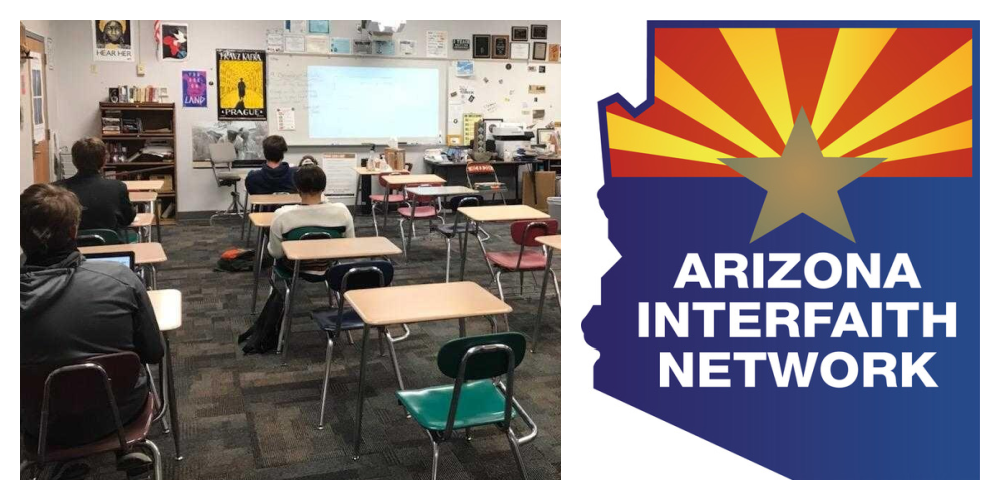
Through an intense mobilization campaign that engaged voters across the state, Valley Interfaith Project, with Pima County Interfaith, Northern Arizona Interfaith Council and a coalition of education allies, leveraged passage of Prop 208 which will restore millions of dollars to K-12 education funding.
[Excerpts from Jewish News below]
“Quality education is at the core of who the Jewish people are and how we have survived for thousands of years,” said Rabbi John Linder of Temple Solel, a member of the Arizona Interfaith Network Clergy Caucus. “And we look at quality education as reflecting the common good of the community.”
AIN was among five organizations that worked for the last four years to pass the Invest in Ed initiative. Other coalition organizations include the Arizona Center for Economic Progress, the Arizona Education Association, Children’s Action Alliance and Stand for Children.
Arizona has among the lowest spending per student on K-12 education in the country, and the state cut funding further during the 2008 recession. Proponents argue that over a decade later, it’s time for the state to restore what was lost.
“It’s doing the right thing, because it’s getting us closer ... to that budget we had before they cut everything,” said Kim Klett, Holocaust literature and AP English teacher at Dobson High School in Mesa. She is also on the board of directors of Phoenix Holocaust Association. “They took so much and it was never restored, and so it’s going to be able to restore a lot of those things that we had before.”
Pervasive spending cuts and low education funding have led teachers like Klett to spend their own money or hold fundraisers to purchase school supplies, such as a set of books for her classroom.
“We put in a lot of hours outside of our school day, and I just feel like fundraising for materials that you need in your classroom should not be one of those other things that we have to do,” Klett said, “and yet we do it all the time.”
To Linder, the Invest in Ed initiative represents a welcome change for education funding in Arizona.
“Things that we value, we invest in,” Linder said. “And the reality in Arizona is that our state has simply failed to keep up with basic needs and providing a competitive livelihood for teachers and keeping class sizes manageable.”
Proposition 208 creates a new revenue stream for Arizona public schools by imposing an income tax increase of 3.5% on individuals earning more than $250,000 and married couples earning more than $500,000.
...
“Our public system is teetering because teachers can’t afford to stay in the teaching field or they choose to go to another state because they’re simply not valued here, and there are thousands of classrooms without a qualified teacher,” Linder said. “That should not be acceptable to the state of Arizona.”
Invest in Education Initiative Passes, Injects New Funds into Arizona Schools, Jewish News [pdf]
Historic Win as Arizona Voters Say Yes to Propostion 8, Invest in Education [pdf]
December 09, 2020